Clerk.io Review
AI-powered ecommerce personalization with search, recommendations, and email
Personalization & CDP · Paid
Overview
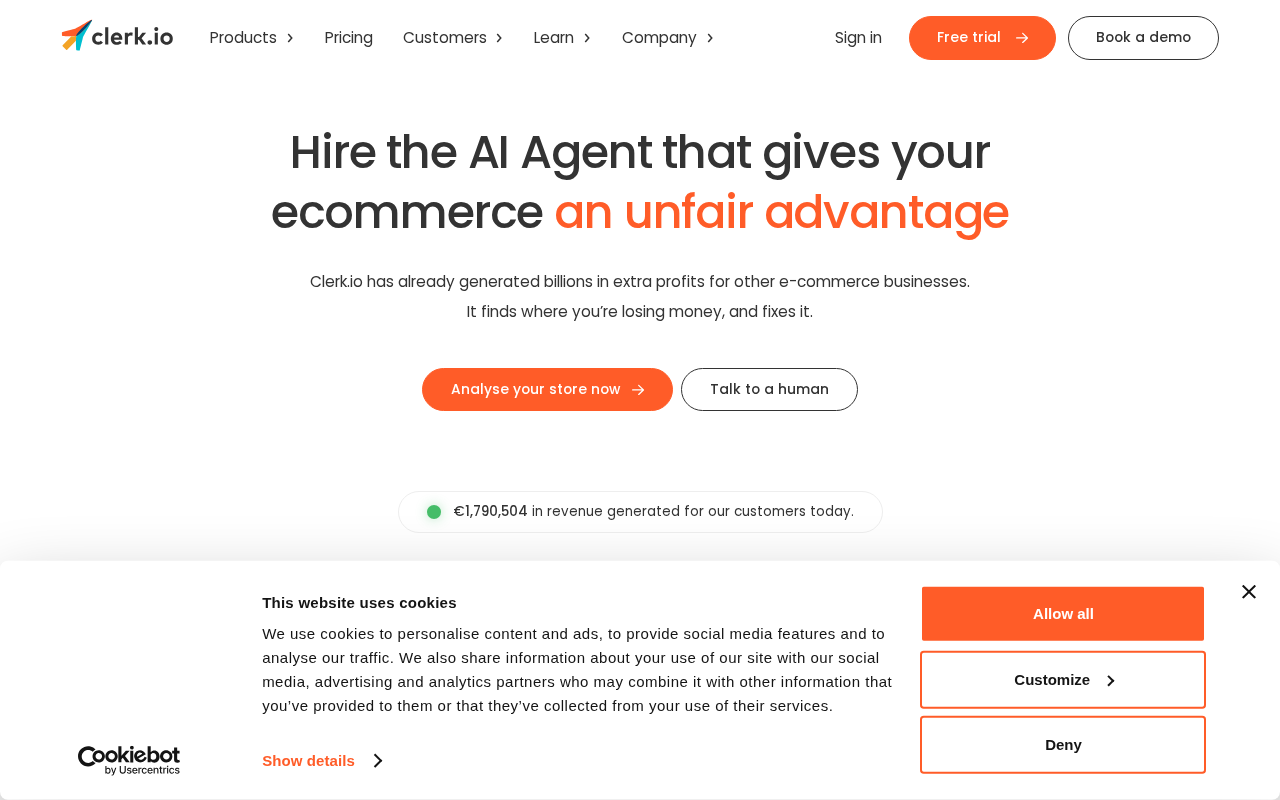
Clerk.io is an AI ecommerce personalization platform that helps online stores optimize every customer touchpoint with behavior-driven intelligence. Its modular AI platform covers four core areas: **personalized site search** that eliminates zero-result dead ends by combining browsing behavior, sales data, and real-time inventory availability; **product recommendations** across homepage, category pages, product pages, and cart using multi-algorithm AI; **email personalization** with behavior-triggered product feeds; and **audience segmentation** that dynamically groups customers by intent signals rather than static rules. Clerk.io's unified data platform ensures all personalization modules share the same customer profile, so a shopper who searched for running shoes sees consistent recommendations across search, browse, and email rather than conflicting signals from siloed tools. **Cookieless by design:** Clerk.io uses first-party behavioral data and session-based signals instead of third-party cookies, making it resilient to privacy regulations and browser restrictions. The platform serves over 2,500 stores worldwide and reports 15-30% average sales lift from its personalization suite. Pricing starts at $119/month, making it accessible to mid-market ecommerce while scaling to enterprise needs. Integrations include Shopify, Magento, WooCommerce, BigCommerce, and custom platforms via REST API. Clerk.io competes directly with Nosto, Dynamic Yield, and Algonomy in the ecommerce personalization space, positioning itself as the AI-first alternative that unifies search, recommendations, and email under one behavioral data engine.
AI Capabilities
- AI product recommendations
- AI site search
- AI email personalization
- AI audience segmentation
- Predictive analytics
Key Integrations
Pricing
Clerk.io is sold on paid plans.
Custom pricing based on traffic and modules; monthly to yearly contracts available
Current plans and limits live on the Clerk.io pricing page.
Review notes
Researched from public documentation, the source repository, and vendor materials. Not a hands-on test.
Clerk.io sells personalization as four modular products: site search that routes around zero-result dead ends, product recommendations across every page type, behavior-triggered email feeds, and dynamic audience segments built on intent signals. Each module installs over your existing store and the models learn from browsing and sales data quickly, so you buy only the pieces you need. That modular entry is the honest way into personalization.
The modular model means the full stack gets expensive, and merchandising rules need real configuration to stop recommendations going generic. The engine needs traffic to learn from, so small catalogs and low-traffic stores see modest gains while paying the same integration effort. It suits mid-size ecommerce with genuine sales volume and a merchandiser who will tune the rules. Plan the rollout module by module instead of switching everything at once.
Verdict
Solid modular pick for mid-size stores with traffic to feed the models. Thin catalogs get little from it.
Pros and cons
| Pros | Cons |
|---|---|
| ✓ AI capabilities: AI product recommendations | ✗ Closed source - no self-hosting option |
| ✓ Native integrations include Shopify, WooCommerce, Magento (7 listed) | |
| ✓ API access for custom integrations |
Building your martech shortlist?
The weekly newsletter: one tool teardown, one workflow, no fluff. Free.
Frequently asked questions
What is Clerk.io?
AI-powered ecommerce personalization with search, recommendations, and email. It ships with AI product recommendations, 7 listed integrations. MartechSignal's review covers features, pricing, and how it compares to alternatives.
How much does Clerk.io cost?
Clerk.io uses paid pricing. See the vendor's pricing page for current plans.
Is Clerk.io a good Personalization & CDP tool in 2026?
Solid modular pick for mid-size stores with traffic to feed the models. Thin catalogs get little from it.