Attio Review
AI-native CRM with real-time data enrichment and agentic revenue workflows
CRM · Freemium
Overview
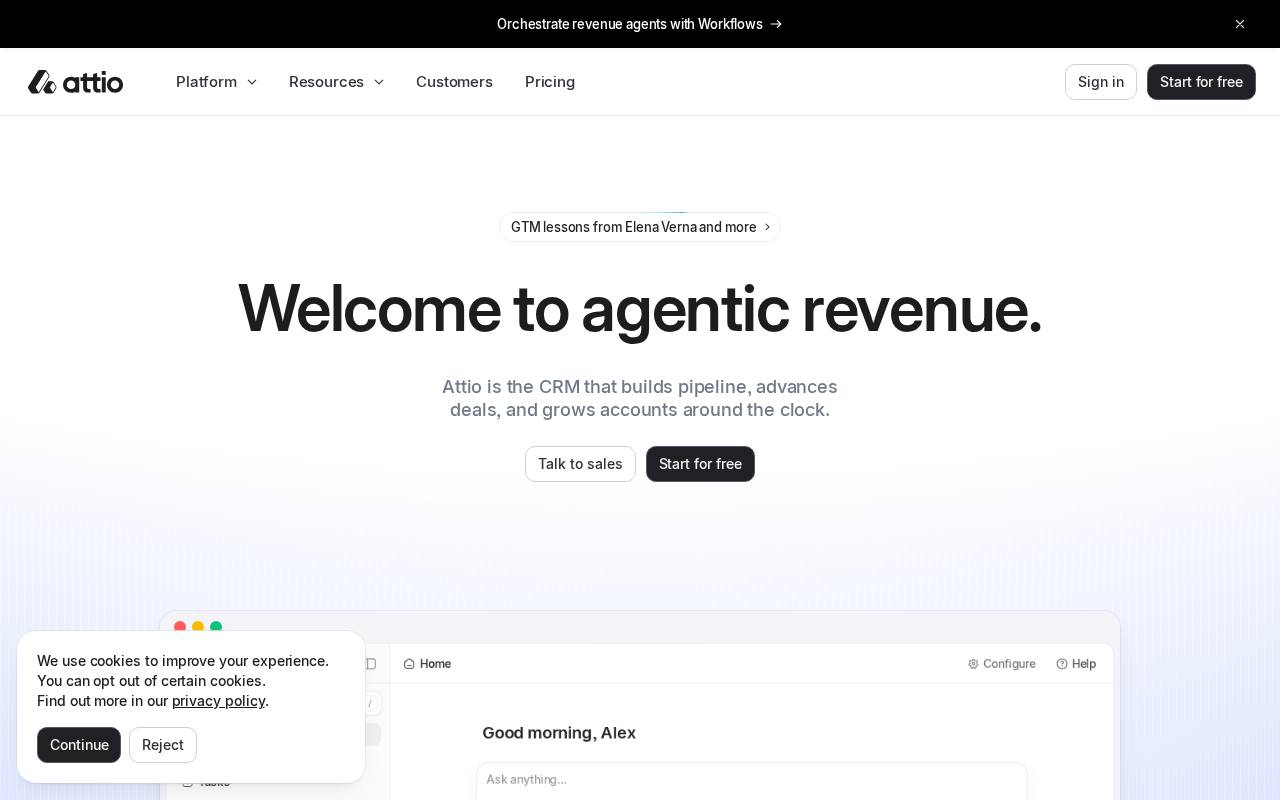
Attio is a CRM rebuilt from the data model out, rather than having AI bolted onto a 20-year-old schema. It's an AI-native system of record for revenue teams, and the fastest-growing vendor in the CRM category on Ramp's spending data. The core difference is the data model. You shape objects around your business (companies, deals, partners, workspaces, investors) rather than bending your motion into a fixed schema. Two-way relationship attributes link records across objects, so a deal points at a partner and changes reflect on both sides. Connect your team's inboxes and calendars, and Attio auto-builds enriched records with relationship intelligence: who first spoke to whom, who has the strongest relationship, when the last contact was. AI is built into the data model rather than sitting on top as a sidebar assistant. Records research themselves. Fields fill themselves. Call recordings write their own summaries. Workflows handle deal-stage automation, routing, enrichment, and sequences natively, and a concrete inbound pattern (form, enrichment, scoring, routing, Slack ping) cuts lead triage time by 83% for teams like Granola. Pricing starts free for 3 seats, Pro at $79/user/mo (custom objects, AI attributes), Enterprise with SSO and unlimited objects. The limitation: Attio is not an all-in-one suite. There's no marketing automation, help desk, or landing pages, so you connect dedicated tools around it. For startups of 1-200 people running sales-led or PLG motions who want a fast, flexible CRM and don't need the HubSpot monolith, Attio is the right call. For teams requiring one tool for marketing, sales, and service, it's the wrong one.
AI Capabilities
- AI data enrichment
- AI email drafting
- AI meeting notes
- Agentic workflows
- AI pipeline insights
Key Integrations
Pricing
Attio is freemium, with a free tier to start, paid plans start at $29/mo.
Free (3 seats); Plus $29/seat/mo; Pro $69/seat/mo; Enterprise custom; annual billing
Current plans and limits live on the Attio pricing page.
Review notes
Researched from public documentation, the source repository, and vendor materials. Not a hands-on test.
Attio positions itself as the CRM that behaves like a database. The data model is the differentiator: every object, from company to deal to custom field, is a record with relations, and you can add fields without a settings maze. Attribute-based lists update live, which kills the stale-segment problem most CRMs have. The trade-off is a steeper learning curve than HubSpot; the UI assumes you think in relations.
Pricing starts free for limited records and scales per seat into the hundreds. For a team that already runs its go-to-market logic in spreadsheets or Notion, Attio is the closest thing to a relational database with a CRM skin.
Verdict
Worth a look when your CRM needs custom objects and live segments more than it needs a sales methodology out of the box.
Pros and cons
| Pros | Cons |
|---|---|
| ✓ AI capabilities: AI data enrichment | ✗ Paid plans start at $29/mo once past the free tier |
| ✓ Native integrations include Slack, Gmail, Outlook (8 listed) | ✗ Closed source - no self-hosting option |
| ✓ Free tier to evaluate before committing (Free (3 seats); Plus $29/seat/mo; Pro $69/seat/mo; Enterpris) |
Building your martech shortlist?
The weekly newsletter: one tool teardown, one workflow, no fluff. Free.
Frequently asked questions
What is Attio?
AI-native CRM with real-time data enrichment and agentic revenue workflows. It ships with AI data enrichment, 8 listed integrations. MartechSignal's review covers features, pricing, and how it compares to alternatives.
How much does Attio cost?
Attio has a free tier; paid plans start at $29/mo.
Is Attio a good CRM tool in 2026?
Worth a look when your CRM needs custom objects and live segments more than it needs a sales methodology out of the box.