Listmonk Review
Open-source self-hosted newsletter and mailing list manager with a fast Go backend
Open-Source Tools · Open Source · OPEN SOURCE
Overview
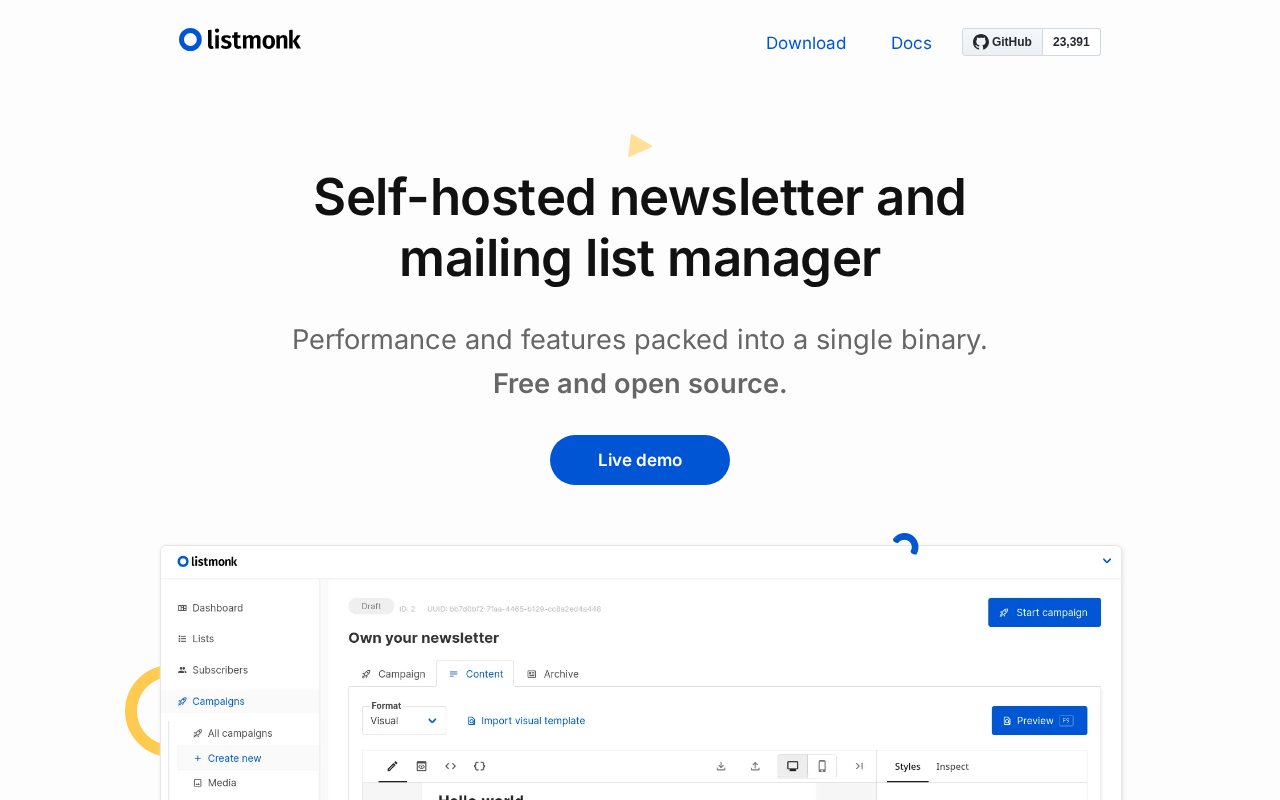
Built as an open-source, self-hosted mailing list manager, Listmonk gives marketing teams a lightweight way to run newsletters, subscriber lists, and email campaigns without relying on a hosted SaaS platform. Its Go backend is designed for speed and low operational overhead, while PostgreSQL handles subscriber and campaign data. The project is free under the AGPL license, with no paid tiers, and it exposes an API for custom workflows. It also supports practical integrations such as SMTP providers, Zapier, and WordPress, making it possible to connect signup forms, automation, and existing site infrastructure. Listmonk is a good fit for technical marketers, developers, and privacy-conscious organizations that want direct control over email infrastructure and subscriber data. Founded in 2019 and based in Bangalore, India, the project has attracted strong open-source interest, with 22,452 GitHub stars. Its AI capabilities are practical rather than central: AI-assisted template editing can help refine email layouts and copy, while AI campaign analytics can support performance review and optimization. These features sit alongside standard campaign tools such as segmentation, templates, and reporting. Compared with commercial alternatives such as Mailchimp, Campaign Monitor, or ActiveCampaign, Listmonk trades managed convenience for ownership, lower recurring costs, and greater flexibility. Teams will need to handle hosting, deliverability configuration, and maintenance themselves, so it is less suited to users who want a fully managed service. It is best for technically capable teams, indie publishers, SaaS companies, and nonprofits that want an open-source email platform with API access, self-hosted data control, and optional AI assistance for campaign production and analysis.
AI Capabilities
- AI-assisted template editing
- AI campaign analytics
Key Integrations
Pricing
Listmonk is free to self-host under the AGPL-3.0 licence.
Free and open-source (AGPL); self-hosted; no paid tiers
Current plans and limits live on the Listmonk pricing page.
Review notes
Researched from public documentation, the source repository, and vendor materials. Not a hands-on test.
Listmonk is what you pick when the mailing list is the product: one Go binary plus Postgres, a million-subscriber capacity on modest hardware, and an API for everything. Campaign templating uses Go templates, bounce and complaint webhooks are built in, and subscriber imports handle hundreds of thousands of rows without breaking a sweat.
It is infrastructure, not a marketing suite. No automation journeys, no landing pages, no sign-up form builders beyond a basic embed. Teams pair it with their own forms and workflow tools. If you want an ESP you administer rather than rent, this is the strongest open-source option available.
Verdict
The strongest self-hosted mailing platform we have run; bring your own forms and workflows.
Pros and cons
| Pros | Cons |
|---|---|
| ✓ AGPL-3.0 licence with free self-hosting | ✗ No hands-on test - this assessment is based on vendor documentation and the public repository |
| ✓ AI capabilities: AI-assisted template editing | |
| ✓ Established community (23,343 GitHub stars) |
Building your martech shortlist?
The weekly newsletter: one tool teardown, one workflow, no fluff. Free.
Frequently asked questions
What is Listmonk?
Open-source self-hosted newsletter and mailing list manager with a fast Go backend. It ships with AI-assisted template editing, 23,343 GitHub stars. MartechSignal's review covers features, pricing, and how it compares to alternatives.
How much does Listmonk cost?
Listmonk is open source - AGPL-3.0 licensed and free to self-host; the public repository carries 23,343 stars; native integrations cover PostgreSQL, SMTP, Zapier. You pay in server time and maintenance, not licences.
Is Listmonk a good Open Source Tools tool in 2026?
The strongest self-hosted mailing platform we have run; bring your own forms and workflows.