Tray.io Review
AI-powered integration platform for building custom automation and AI agents
Workflow Automation · Enterprise
Overview
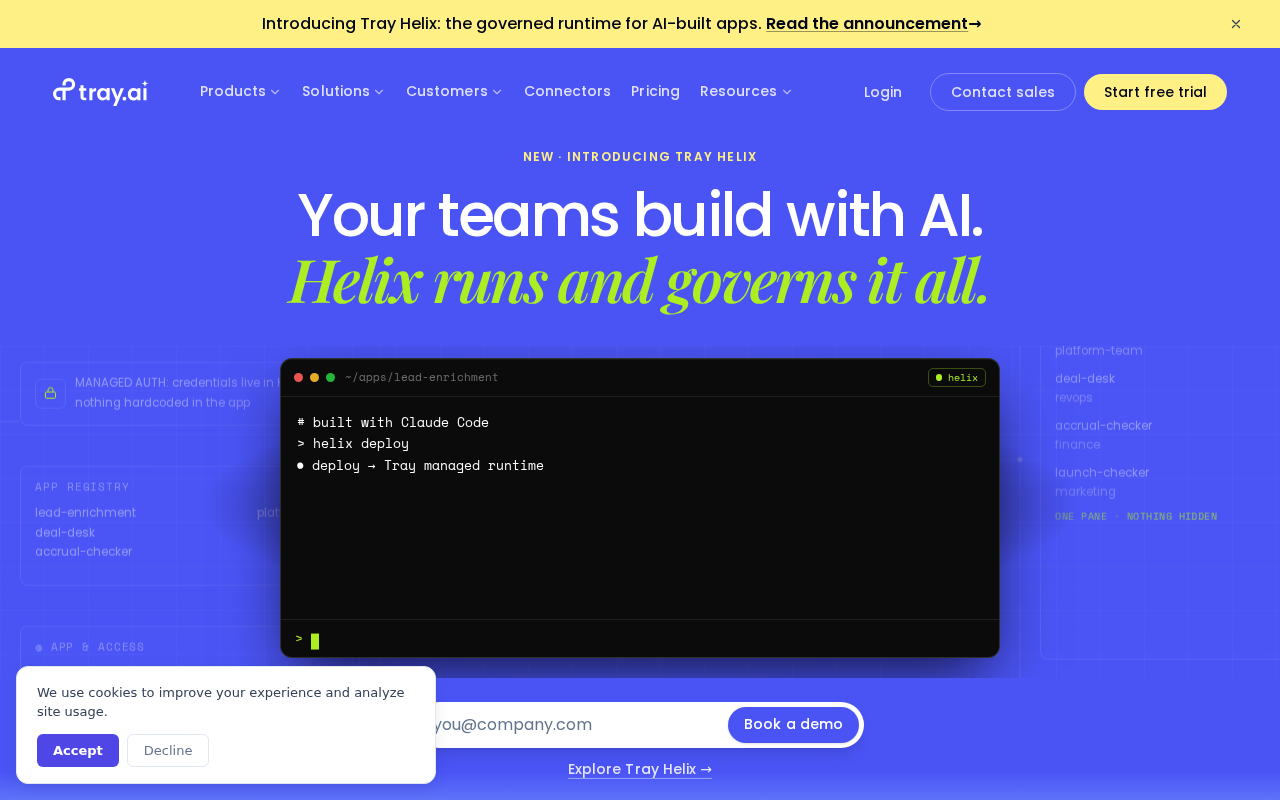
Tray.io, now trading as Tray.ai, calls itself an AI orchestration platform rather than an iPaaS, and the shift shows in what shipped during 2026. Tray Headless arrived in June with plugins for Claude Code and Codex plus a headless MCP server, followed by MCP dynamic authentication, Guardian Log Masking, and a Tray Sync CLI in August. The newest piece is Tray Helix, announced August 2026: a managed runtime that takes apps your team builds with AI coding assistants and puts them into production with IT visibility, security controls, and a named owner on each one. The automation core still works the way the docs teach it: get data from one service, do something with it, send it to another. Workflows start from a service trigger, a webhook, or a scheduled poll, and the quickstart walks a Typeform-to-Google-Sheets template with a Slack notification, introducing project config, conditional logic, callable workflows, the data mapper, and environment variables along the way. Around that sits a catalog of 700-plus pre-built connectors, a connector SDK for anything missing, on-premise connectivity, API management, and an Embedded product for SaaS teams shipping integrations to their own customers. AI is layered rather than bolted on. Every plan includes the AI Palette, VectorTables, and built-in AI tools, Merlin Build assists workflow construction, and the paid Agent Development add-on bundles Merlin Agent Builder with Agent Gateway, which turns those connectors into governed MCP tools with access control, observability, and cost governance. Pricing is published as tiers but not as prices. Pro, Team, and Enterprise are described by workspaces, log retention, and insights windows, with HIPAA, SSO, regional hosting, and Tray IDP sold as add-ons and usage metered in Tasks. Teams that need agents governed inside a compliance boundary are the buyers. Small automation projects are not.
AI Capabilities
- Merlin Agent Builder
- Agent Gateway for MCP
- AI Palette
- Merlin Build
- VectorTables
- Tray IDP
Key Integrations
Pricing
Tray.io is sold on quote-based enterprise contracts.
No published prices. Three tiers (Pro, Team, Enterprise) described by workspaces, log retention, and insights windows; usage metered in Tasks across integration, automation, MCP, and agents. HIPAA, SSO, regional hosting, and Tray IDP are paid add-ons. Demo or sales call required.
Current plans and limits live on the Tray.io pricing page.
How to install
- Start with the Quickstart in the Tray documentation. It teaches three moves: get data from a service, do something with it, and send it somewhere else.
- Install the Add Typeform survey responses to Google Sheets template from the library. The docs estimate ten minutes including a free Typeform account, and it hands you a service trigger, a data mapper, and a Slack notification to pull apart.
- Learn the data-handling concepts the quickstart introduces: project config variables, conditional logic, callable workflows, input schemas, and environment variables.
- Connect your first apps under Authenticating connectors. Service connectors hold their own OAuth, JWT, API key, or basic auth; anything without a connector goes through a universal HTTP step or the connector SDK.
- When you are ready for agents, look at Tray Headless, which ships plugins for Claude Code and Codex plus a headless MCP endpoint with EU and APAC regions, and at the Agent Development add-on for Agent Gateway and Merlin Agent Builder.
Requirements
Tray.ai is hosted, so there is nothing to install beyond an account and a browser for the builder. The constraints are contractual: workspaces, log retention windows, and insights history scale by tier, and on-premise connectivity, regional hosting, HIPAA, and SSO are Enterprise-tier or add-on items. Verify those before you design around them.
Best for
Mid-market and enterprise teams running automation as a governed program rather than a pile of individual scripts: multiple workspaces, environments, audit trails, and now AI agents that need access control and observability.
Not for
Small teams and solo operators. Prices are quoted by sales, usage is metered in Tasks that complex workflows consume quickly, and free tiers from Zapier or self-hosted n8n cover simple automation at a fraction of the cost.
Review notes
Assessed from Tray.ai's documentation and pricing pages rather than a built workflow. The platform renamed and re-scoped during 2026: Tray Headless shipped in June with plugins for Claude Code and Codex and a headless MCP server, followed by MCP dynamic authentication, Guardian Log Masking, and a Sync CLI, and Tray Helix arrived in August as a managed runtime for AI-built apps.
The automation core is conventional and well documented. The quickstart teaches get data, do something, send data through a Typeform-to-Google-Sheets template, and introduces project config, conditional logic, callable workflows, the data mapper, and environment variables. The catalog claims 700-plus pre-built connectors, and the public connectors page names Salesforce, Slack, HubSpot, Snowflake, Zendesk, NetSuite, BigQuery, Google Sheets, OpenAI, and Anthropic among them.
Governance is the actual product difference, and much of it is priced as an add-on. HIPAA, SSO, regional hosting, and Tray IDP sit outside the base tiers, and Agent Gateway and Merlin Agent Builder ship together as a paid Agent Development add-on. Prices are not published; tiers are described by workspaces, retention, and insights windows, and usage is metered in Tasks.
Verdict
An integration platform that has rebuilt itself around agents, MCP, and governance faster than most of its category. Model your task consumption and confirm the compliance add-ons you need before signing.
Pros and cons
| Pros | Cons |
|---|---|
| ✓ AI capabilities: merlin Agent Builder | ✗ Closed source - no self-hosting option |
| ✓ Native integrations include Salesforce, Slack, HubSpot (10 listed) | ✗ Enterprise pricing is quote-based - no public numbers |
| ✓ API access for custom integrations |
Building your martech shortlist?
The weekly newsletter: one tool teardown, one workflow, no fluff. Free.
Frequently asked questions
What is Tray.io?
AI-powered integration platform for building custom automation and AI agents. It ships with merlin Agent Builder, 10 listed integrations. MartechSignal's review covers features, pricing, and how it compares to alternatives.
How much does Tray.io cost?
No prices are published. The pricing page names Pro, Team, and Enterprise tiers and describes them by workspaces, log retention, and insights windows, with usage metered in Tasks and add-ons such as HIPAA, SSO, regional hosting, and Tray IDP priced separately.
Is Tray.io a good Workflow Automation tool in 2026?
An integration platform that has rebuilt itself around agents, MCP, and governance faster than most of its category. Model your task consumption and confirm the compliance add-ons you need before signing.
What is Tray Helix?
Announced in August 2026, Helix is a managed runtime for apps your team builds with AI coding assistants such as Claude Code, Codex, and Cursor. Tray's framing is that fewer than 5 percent of AI-built apps reach production and the ones that do ship ungoverned, so Helix deploys them onto Tray's runtime with IT visibility, security controls, and a named owner on everything that ships.
Does Tray.ai support MCP?
Yes, from several directions. Tray Headless includes a headless MCP server with regional endpoints in the EU and APAC and dynamic authentication added in June 2026. The Agent Gateway add-on publishes any of the 700-plus connectors as an MCP tool with access control, observability, and cost governance. Tray also documents how to connect external agents to those services.
How much does Tray.ai cost?
No prices are published. The pricing page names Pro, Team, and Enterprise tiers and describes them by workspaces, log retention, and insights windows, with usage metered in Tasks and add-ons such as HIPAA, SSO, regional hosting, and Tray IDP priced separately. Every call to action is a demo request, so budgeting happens in a sales conversation.
Tray.ai or Zapier: when is the upgrade worth it?
Zapier fits single-task automations owned by individuals. Tray fits programs: multiple workspaces, callable workflows, data tables, version control through the Sync CLI, log masking, and audit trails, plus agents governed through Agent Gateway. If you need governance, compliance certifications, or centrally controlled agents, Tray earns its cost. If you are wiring five apps together, it does not.